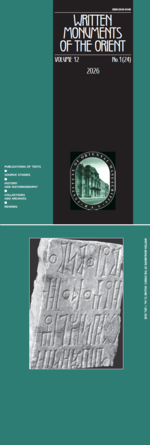
 | Written
Monuments
of the Orient Volume 12, No. 1(24), 2026
ISSN 2410-0145 Issued twice a year
The entire issue as a *.PDF file CONTENTS
Minasyan, Tamara & Eliazyan, Gayane & Khorozian, Armin. A Codicological, Artological and Material Analysis of the Gospel Matenadaran 378 in the Context of the Artsakh Manuscript Tradition of the 13th Century — 3
Manuscript 378 (Ms. 378), housed at the Mesrop Mashtots Matenadaran in Yerevan, is the oldest illustrated manuscript to have reached us from Artsakh (Nagorno-Karabakh), dating back to the 13th c.1 Although the colophons do not specify the exact location where the manuscript was created, the information they contain suggests that it was written either in an ancient sanctuary on the site of the current St. John the Baptist Church in Gandzasar, or in the nearby Khokhanaberd fortress, which was the residence of princes.2 This hypothesis is substantiated by the fact that the St. John the Baptist Cathedral in Gandzasar was constructed after the creation of the Gospel, and the territories were already the princely domains of the Hasan-Jalalyans.3 The study is structured in two main parts. The initial section presents a codicological and artistic analysis: the miniature system of Ms. 378 (comprising canon-tables, title pages, marginal ornaments and iconographic features) is considered in the context of the continuity of the Armenian tradition and regional interactions. These observations are complemented by manuscript colophons, which act as a significant source for the study of the history and cultural environment of Artsakh in the 13th c. The codicological and artistic analysis of the first part is complemented by the chemical and material study presented in the second part, which allows for an assessment of the technical basis of the manuscript’s creation and the exclusivity of the materials used. The study revealed the presence of high-value dyes, including cochineal, ultramarine, safflower, lead white and high-purity gold. The results obtained permit a new and comprehensive evaluation of the artistic and historical merits of the manuscript, emphasising its exceptional material basis. Consequently, the Ms. 378 is regarded not only as an artistic treasure and historical source, but also as a significant material for interdisciplinary research, which occupies a substantial place in the study of Armenian medieval codicology and cultural history. Key words: Ms. 378 Gospel, Artsakh, 13th c., Gandzasar Monastery, miniature, iconography, colophons, dyes, X-ray fluorescence analysis (XRF), infrared spectroscopy analysis (FT-IR)
Ivan V. Bogdanov. On Birds and Beasts in the Donation Formula on the Satrap Stela (URK. II: 20.13) — 39
The subject of this lexicological study is one of the final sections of the Satrap Stela (lines 15–16; URK. II: 20.9–16) with a list of goods received by the Temple of Horus the Lord of Pe and the goddess wADjt from the region pA-tA-n-wADjt “the land of the goddess wADjt”. This list is a part of the decree of satrap Ptolemy to the temple of Buto. The second part of the donation formula contains a list of goods: wild birds, beasts and field crops. The meanings of the following phrases are clarified: 1. Apdw n(w) Hrj-jb Axt “birds of the mid-flood season”; 2. ntj anx m znf “those who feed on blood” = “beasts of prey” (URK. II: 20.13). It is concluded that the compiler of the Satrap Stela text altered the usual edict standards to impart a poetic quality by mixing phrases from different contexts. Following the principles of poets and theologians of Egyptian temples, he imbued it with multiple layers of meaning. Key words: Satrap Stela, ancient Egyptian phraseology, Egypt in the late 4th c. BC, ancient Egyptian epigraphy, Egyptian language
Serge A. Frantsouzoff. A Sabaean Goddess in Наdramawt and Some Peculiarities of Her Cult at the Temple Rahban (Site Raybân) — 50
In the present article the author examines some distinctive features of the veneration of the Sabaean goddess Dhât Ḥimyam in the temple Rahbân located at the site Raybûn in the western part of inland Hadramawt. The article is based on a selection of inscriptions discovered during the excavations of the above-mentioned sanctuary by the Soviet-Yemenite Complex Expedition in 1984, 1988–1990. Special attention is given to: the syncretism of Dhât Himyam and the Qatabanian goddess Dhât Ṣahrân, some of the functions of secondary deities subjugated to Dhât Ḥimyam, a re-interpretation of a votive object called bḥt dedicated to her, and the connection of this goddess with land property. Key words: Ancient Yemen, South Arabian epigraphic documentation, Hadramitic and Sabaic languages, site Raybun in inland Hadramawt, Soviet excavations of Raybun in the eighties, inscription from the temple Rahban (Raybun I)
Artiom V. Mesheznikov, Tatiana V. Klementeva. Sanskrit Fragments of Hīnayāna Sūtras (SI 3332/20, SI 3333/1) in the Serindia Collection of the IOM RAS — 91
The article deals with two unpublished Sanskrit fragments of Hīnayāna sūtras (SI 3332/20, SI 3333/1) from Central Asia kept at the Institute of Oriental Manuscripts of the Russian Academy of Sciences (Serindia Collection, IOM RAS). The M.I. Lavrov’s subcollection of the Serindia Collection contains 18 Sanskrit fragments (under the pressmarks SI 3332/2, SI 3332/12–24, SI 3333/1–2, SI 3334 and SI 3335), which academician S.F. Oldenburg (1863–1934) identified with the help of the Pāli Canon as “Cakravartisūtra” (Pāli: “Cakkavatti-sīhanāda-sutta”) and “Payasvī-sūtra” (Pāli: “Pāyāsi-sutta”). Apparently, S.F. Oldenburg intended to publish them, since the Serindia Collection holds his partial transliterations (several lines) of the fragments, but for some reason he was unable to carry out his plan and to introduce into scientific circulation these unique manuscripts containing rare Sanskrit examples of Hīnayāna sūtras. One of these sūtras (i.e. “Payasvī”), to our knowledge, is not represented in any other Sanskrit manuscript collection. The two fragments under study come from the Kucha oasis city-state of the Tarim Basin, are written in the North Turkestan Brāhmī script on paper, and can be conventionally dated to the 8th–9th cc. Based on their external features and content analysis, we found out that these fragments form two almost conjoining parts of a single folio, which contains the final part of “Cakravarti-sūtra” and the opening lines of “Payasvī-sūtra”. The article offers a description of the fragments, transliteration, comparison with Pāli and Chinese versions of the sūtras, translation and facsimile reproduction. Key words: Buddhist canons, Hīnayāna, manuscripts, Sanskrit, Sergei F. Oldenburg, Serindia Collection Tatiana V. Ermakova. Ceylonese Buddhist Priest Subhuti’s Letters to I.P. Minayev: Preface, publication, commentaries — 107
Letters of the 19th c. famous Ceylonese Buddhist priest Subhuti to the Indologist I.P. Minayev are a valuable historical source. Addressed to the Russian scholar, these relatively brief messages touch on a range of topics essential for understanding both I.P. Minayev’s scholarly interests and the state of Buddhist manuscript culture and Buddhism in Ceylon in the 1870s. Subhuti’s letters are kept in I.P. Minaev’s personal collection at the Archives of the Orientalists at the Institute of Oriental Manuscripts of the Russian Academy of Sciences. This is the first time they have been published with commentary. Key words: I.P. Minayev, Buddhist priest Subhuti, Archives of the Orientalists IOM RAS, Buddhism at Ceylon, manuscript culture of Ceylon |