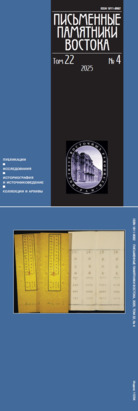
 | PIS'MENNYE
PAMYATNIKI
VOSTOKA Vol. 22, No. 4 (63)
Winter 2025
Journal based in 2004
Issued quarterly
Full text as a *.PDF file PUBLICATIONS
HISTORY, PHILOSOPHY, PHILOLOGY
WU Jing. Tang Taizong (627–649). The Essentials of Government of Zhen-guan Period.
Chapter 6.18. On Prudence and Modesty / Translation and comments by Irina F. POPOVA — 7
The published text presents a translation of chapter 6.18 from “The Essentials of Government of Zhen-guan Period” (Zhen-guan zheng yao 貞觀正要), a treatise by historian Wu Jing 呉兢
(640–749), which represents dialogs of Taizong (627–649), the second emperor of Tang, with his
closest dignitaries.
Keywords: Tang Taizong, Wu Jing, “The Essentials of Government of Zhen-guan Period”, discourses of the Tang Dynasty dignitaries.
Igor A. ALIMOV. Two Novels by Wang Ming-qing — 15
This publication presents to the reader a translation of two short stories from the Tou xia lu
(投轄录 “Records of the Tossed Linchpin”) collection by the Song Dynasty writer Wang Ming-qing (
王明清, 1127 — after 1202). The Russian translation is preceded by essential information about the
author and his collection.
Keywords: Old Chinese prose, Song Epoch, Wang Ming-qing, Tou xia lu, history of the Xiaoshuo prose.
Vladimir L. USPENSKY. A Buddhist Poem by the Shunzhi Emperor in Tibetan Translation — 23
The article introduces a Tibetan translation of the well-known Chinese Buddhist poem “In
Praise of Monastics” by the Shunzhi emperor (reigned in 1644–1661) of the Qing dynasty. This poem
was mistakenly ascribed by an anonymous Tibetan translator to the Kangxi emperor (reigned in
1662–1722). The Tibetan translation was printed from woodblocks at the Amchog Monastery in the
present-day Gansu province of China. It was brought to Russia by Buryat scholar Bazar Baradiin. A
comparison of the Chinese original with this slightly abridged Tibetan translation shows that it does
not follow the original literally.
Keywords: Shunzhi emperor, Tibetan poetry, Qing dynasty, Buddhism, Chinese poetry.
RESEARCH WORKS
HISTORY, PHILOSOPHY, PHILOLOGY
Viacheslav M. RYBAKOV. The System of Plenipotentiary Envoys in the Tang China (618–907) — 30
The system of plenipotentiary envoys (Shi 使) was extremely important for China of the
Tang period (618–907). It was established immediately after the new dynasty came to power, and
soon turned into a permanent element of the state structure, becoming eventually the bane of the great
Tang Empire. The titles of such commissioners were very numerous, some often were replaced by
others, and there is still a lot of confusion about this issue. A separate problem is how to translate the
Chinese terms of assignments into Russian. In this article, the author—using materials from Chinese
sources—attempts to briefly systematize the essential information about such envoys.
Keywords: traditional Chinese administration, administrative terminology, translation of administrative terms.
Helena P. OSTROVSKAIA. Through the Pages of the Abhidharma Encyclopedia: A Description
of Buddhist Fasting — 44
The article is devoted to ethical analysis of Buddhist daily fasting, the most complete
description of which is contained in the fourth section of Vasubandhu’s treatise (4th–5th centuries)
Encyclopedia of Abhidharma with Commentary. The article discusses the concept of fasting as a spiritual gift addressed to the type of lay people who crave sensual pleasures and are not yet able to
completely abstain from immoral actions. It is demonstrated that Vasubandhu interpreted fasting as a
combination of eight factors. Of these, four factors (abstaining from killing, stealing, adultery, lying) are the practice of virtuous behavior. One factor is the practice of sobriety (abstinence from
intoxicating substances). And there are three factors of asceticism: refusal to rest on a high or wide
bed, refusal to engage in entertainment (dancing, music, singing) and to concern oneself with one’s
own attractiveness, refusal to eat during fasting days. The good moral effect of fasting is achieved
only if the totality of factors is observed. Partial practice of fasting is useless.
Keywords: Buddhist fasting, late Abhidharma, discipline of fasting, eight factors of fasting, sobriety, asceticism.
Elena N. EMELCHENKOVA. Tradition and Innovation in Language: A Case Study
of the Development of Chemical Terminology in the 19th-Century China — 53
The history of modern chemical terminology used in Chinese-language scientific discourse
offers a vivid and compelling example of how, against the backdrop of shifting epistemological
paradigms, traditional worldviews—formed over millennia—intertwined with innovative approaches
and the creative ingenuity of native Chinese speakers and users of the ancient Chinese script. This
article seeks to demonstrate how these complex and multifaceted processes influenced the
development of inorganic chemical terminology, and how chemistry, having become an independent
scientific discipline, penetrated the organic fabric of the Chinese language. Nowadays, this has
triggered a new wave of linguistic creativity in online literature and digital communication in China.
The article analyzes the methodological challenges faced in the 19th century by the pioneers of
Chinese scientific terminology—translators John Fryer and Xu Shou—who devised an ingenious
method for generating Chinese words for chemical elements. It also discusses the distinctive aspects
of neographic innovation in the present-day context.
Keywords: Chinese language, Chinese chemical nomenclature, names of chemical elements, borrowings, neologisms, new characters, Xu Shou, John Fryer.
LIU Ruomei. The Study of Chinese Grammar by Western Sinologists — 67
Language is an instrument used for international exchange of mankind in the long course
of its formation and development. Territorial barriers and ethnic differences resulted in the formation
of very different languages, with every language having its own grammar and unique norms. This
paper focuses on the five most important grammars of Chinese written by Western Sinologists:
A Grammar of the Chinese Language by Robert Morrison (1782–1834), Les élémens de la grammaire chinoise by Jean-Pierre Abel-Rémusat (1788–1832), Arte China by Joaquim Afonso Gonçalves
(1781–1841), Chinese Grammar by Nikita Ya. Bichurin (1777–1853), and An Experience of Mandarin Grammar with Texts for Exercises by Petr Shmidt (1869–1938). These seminal works laid the groundwork for the study of the Chinese language by Western scholars and first introduced the use of Western linguistic categories into this study.
Keywords: Сhinese language, grammar, “A Grammar of the Chinese language”, Robert Morrison (1782–1834), “Élémens de la grammaire chinoise”, Jean-Pierre Abel-Rémusat (1788–1832), “Arte China”, Joachim Alphonse Gonçalves (1781–1841), «Китайская грамматика», Nikita Ya. Bichurin (1788–1853), «Опыт мандаринской грамматики с текстами для упражнений», Petr P. Schmidt (1869–1938).
Nikolay N. DYAKOV. Woman in Tunis from Islamization to Colonialism in the Work
of Tahar al-Haddad (1899–1935) — 74
The early 20th century opens the beginning of a new epoch in the history of reformation
and renovation movement in the Maghreb, as well as in the whole Arab East. The problem of
women’s status in the Muslim society started to be viewed from a new angle in the works by the
outstanding Tunis thinker Tahar al-Haddad (1899–1935), who wrote a treatise titled Womens’ Status in the Sharia and Society. The paper focuses on the crucial paragraphs of this work, which is not only a book on the fate of the Muslim woman, but also a fundamental historical and religious study in the social and legal influence of Islam on family relations, on the development of the system of education and upbringing, on contacts with the outer word, including the sphere of the so-called “gender agenda”.
Keywords: Tahar al-Haddad (1899–1935), Muslim family, social and legal position of women in Islamic society.
Polina A. KOMAROVSKAIA. The Cultural Symbolism of Prosperity, Fertility and Wealth
in Shaanxi Folk Songs — 81
Folk songs can be considered one the most revealing sources for studying folk culture.
They clearly reflect dialectal and everyday features, as well as people’s interests and views on life.
The theme of prosperity, fertility and wealth is central to Chinese folk arts and crafts, but it seems to
be much less common in folk songs. Songs often reflect or satirize sorrows and griefs, but a few
optimistic works allow us to see the lives of ordinary Chinese people from a special angle. This article
presents the author’s translations of a number of folk songs from Shaanxi Province, written around
1831–1931.
Keywords: PRC, Shaanxi, Guanzhong, folk song, folk culture, folklore.
HISTORY AND HISTORIOGRAPHY
TEXTOLOGY, CODICOLOGY, PALEOGRAPHY, ARCHEOGRAPHY
Hartmut WALRAVENS. The History of Manchu Studies from the German Language Area
(Part II: To the Middle of the 20th Century) — 89
This is the second part of an attempt of chronicling the history of Manchu studies in the
German-speaking areas; the first part was published in a Festschrift for Claus Schönig, professor of
Turkology at the Free University of Berlin, in 2015. Manchu studies in the present paper mean publications that are based on or deal with texts in the Manchu language; thus the vast area of material on the history and culture of the Qing dynasty is excluded if Manchu sources are not used. This approach allows to present a relatively detailed although concise survey. The arrangement of the material is more of less chronological by individual scholars whose contributions are briefly characterized. The present instalment is dominated by Walter Fuchs (1902–1979) whose publications easily qualify him as one of the outstanding scholars in the field.
Keywords: Manchu studies, German-speaking area, 20th century, Manchu language and literature,
Walter Fuchs (1902–1979).
Vladimir G. DATSYSHEN. Manchu Studies and the Study of Chinese History in Russia
in the 18th–19th Centuries — 101
The article examines the problems of relationship between Manchu Studies and the study
of Chinese history in Russian Sinology. The main attention is paid to the issues of formation and
development, during the 18th–19th centuries, of the St. Petersburg Center for Manchu Studies, which
is currently headed by the leading Russian Manchu scholar T.A. Pang. The work shows the reasons
for which the first Russian Orientalists to become Sinologists had originally been experts in Manchu
Studies and proves that one of the primary tasks of Russian Sinology was the study of the history of
the Qing China. The study is based on manuscripts and rare publications found in archival and library
collections. The author concludes that it was due to Manchu studies of the 18th–19th centuries that
the foundation of traditional Russian Sinology was laid, which is in demand at the present stage of
development of historical research in Russia.
Keywords: history of Russian Sinology, Manchu Studies, history of China, T.A. Pang.
Vasilii V. SHCHEPKIN, Aleksandr A. ILIUKHOV. Documents in Manchu on the Relations
of the Sakhalin Ainu with the Qing Empire in the 18th–19th Centuries from the Hokkaido
University Collection — 114
The article introduces into scholarly circulation a Russian translation of two Manchu
documents related to the contacts of the Sakhalin Ainu with the administration of the Qing Empire in
the late 18th and early 19th centuries. It also describes the history of these documents and their study
by Japanese researchers, as well as the historical context of their appearance. Data are provided on the
place of the Sakhalin Ainu in the system of trade relations in Northeast Asia in the specified period.
Keywords: Qing Empire, Sakhalin, Ainu, Manchus, Primorye.
Nicolas G. PCHELIN. M. Ruggieri: A Jesuit Missionary’s Biography — 124
This publication presents some data on the life and multifarious activity of M. Ruggieri
(1543–1607), a Jesuit missionary and an eminent cartographer and researcher of China, widely known
in international Sinological community. It also demonstrates, using his detailed map of Hainan island
as an example, the process of his profound research into the geography, home policy and ethnology of
China of his time.
Keywords: China, Hainan, Jesuit Order Mission, Guangdong province.
Anthony E. TEREKHOV. Sources of Kuang Yu’s Biography in the Liexianzhuan Manuscript
from the Collection of IOM RAS — 132
This publication raises the question of the sources of Kuang Yu’s biography included in the
manuscript titled Liexianzhuan (Arranged Traditions of Transcendents) from the collection of the Institute of Oriental Manuscripts of the Russian Academy of Sciences. By referring to earlier collections of Taoist hagiography and another biography contained in the manuscript — the one of Liu Yue, it was possible to establish that the text was the result of the merger of two biographies from the collection Liexian quanzhuan (1600): a short biography of Kuang Yu and a more extensive biography of Liu Yue, in which one of the heroes bears the name Kuang Xu. Thus, the biography included in the manuscript combined the stories of two characters — Kuang Yu and Kuang Xu. Further attempts to trace the history of legends about them, conducted on the material of the surviving fragments of lost records of the Liuchao era (220–589) allowed us to establish that the images of both go back to the legend of Kuang Su, which was popular in the 4th–5th centuries in the region of the Lushan mountains. Among other things, the publication provides a complete Russian translation of the biographies of Kuang Yu and Liu Yue contained in the manuscript.
Keywords: “Liexianzhuan”, Taoist hagiography, Kuang Yu, Kuang Xu, Kuang Su, Liu Yue.
Tokio TAKATA. A Note on the Chinese Fragment in Tibetan Script PT1249 — 146
PT1249 is a fragmentary Chinese text written in Tibetan script that earlier has not yet been
identified. The recent research by the writer of this paper reveals that the text is a part of the
interrogation of śikṣamāṇā, who should receive the commandments of Buddhism. The text
consists of the part of Biqiuni jiandu 比丘尼揵度第十七 in the ‘Four-Part Vinaya’ Sifenlü 四分律 with
an introductory passage. Hitherto, no Chinese vinaya texts in Tibetan script have been known.
A Chinese text that completely corresponds to this fragment also does not exist. Nevertheless, this kind
of precept is indispensable for the śikṣamāṇā at the ceremony of receiving the commandments, and she
had to learn the passage by heart. One may say that even an illiterate śikṣamāṇā could receive the
commandments and become a formal nun. Judging from its phonetic characteristics, the transcription system belongs to the period of Tibetan rule. A transliterated text with the corresponding Chinese characters, part of which was recovered from the transcription, is presented in this paper. The presence of the fragment provides many suggestions regarding the social realities of Buddhism and language situation in the Tibetan period of Dunhuang.
Keywords: Chinese in Tibetan script, vinaya text, Tibetan period of Dunhuang, Dunhuang manuscripts.
Marina Ye. KRAVTSOVA. On Collections of the Chu Verses (chuci) of the Song Epoch (960–1279) — 156
The article deals with factual data on chuci (verses of Chu) collections compiled during the
Song epoch (960–1279) and presented both in different Song-time written sources and in the
bibliographical treatise from the official historiographic work Songshi (The History of Song). Most
attention is paid to the information on Chuci zhangju (Chapter and Verse Commentary to the Verses of Chu) collection by Wang Yi (II A.D.) and Chuci buzhu (Verses of Chu with Supplementary Commentary) by Hong Xingzu (1090–1155), as well as to its editions of the Ming (1368–1644) and
Qing (1644–1911) epochs. Taking into account that both texts are available only in their Ming
editions, firstly, it seems quite impossible to identify their original composition and, as a result, the
original composition of the “classical” version of Chuci collection as consisting of 17 poetic pieces
arranged in chronological order. Secondly, the idea that the Chuci zhangju and the Chuci buzhu were
identical also became conventional under the Ming. Thirdly, during the Song there were several
textual versions of the chuci collection, marked by compositional specifics, which could have served
as the basis for Hong Xingzu’s work. There are some reasons to assume that the “classical” version of
Chuci collection, including both Chuci zhangju and Chuci buzhu, became generally accepted in
Chinese literature of the Ming and Qing times after being to some degree influenced by the Chuci
jizhu (Verses of Chu with Complex Commentaries) by the great thinker and littérateur Zhu Xi (1130–1200).
Keywords: Chinese poetry, Chu verses, Chuci collections, Song epoch.
COLLECTIONS AND ARCHIVES
NIE Hongyin. Tangut Manuscripts Recently Collected in the Hangzhou Branch
of National Archives — 168
A batch of Tangut manuscripts and xylographs from a private collection was acquired by the
Hangzhou Branch of the National Archives in early 2024. These monuments prove to be Buddhist
works produced during the Mongol-Yuan period, including Tangut versions of sutras both within and
outside the Tripiṭaka, as well as a few locally created works. Some of these items have counterparts
housed in the Institute of Oriental Manuscripts, Russian Academy of Sciences, while others are unique
and not found in any other global collections. These newly disclosed materials may provide valuable
insights into the Buddhist activities among Tangut descendants during the 13th to 14th cc.
Keywords: Xixia, Tibetan, Mongol-Yuan Dynasty, Buddhism, sutra, scripture.
Dmitry A. NOSOV. The Manchu Collection Donated by the Mongolist Vladimir A. Kazakevich
(1896–1937) to the Asiatic Museum in 1927 — 189
In 1927, Vladimir A. Kazakevich, a well-known Mongolist, donated 13 manuscript books
and two xylographs in Manchu to the Asiatic Museum. The article highlights the main codicological
features indicating that certain storage units from the Manchu fund of the Institute of Oriental
Manuscripts of the Russian Academy of Sciences belong to the collection of Kazakevich. In accordance with the serial numbers assigned by the creator of the collection, the composition of this
collection is briefly described. One of the manuscripts is written in two languages, Manchu and Mongolian, some others have notes in Mongolian. This collection, which includes historical, legal,
didactic and philological works, was acquired by Kazakevich between 1923 and 1927 during one of
his expeditions to Mongolia, possibly in the Dariganga region.
Keywords: Asiatic Museum, manuscript collections, xylograph, Manchu language, Mongolian
language, Mongolia, Vladimir A. Kazakevich.
LIU Liqiu, Ramil M. VALEEV, Roza Z. VALEEVA, Airat N. SAMIGULLIN, Gennady R. SHARAFUTDINOV. “I am Beginning to Think of Leaving My Native Kazan” (1922): S.E. Malov in Kazan,
St. Petersburg and in Expeditions to Chinese Turkestan (1880–1922) (on the 145th Anniversary
of His Birth) — 200
In 2025, the attention of colleagues in Russia and modern Turkic states will be focused on
the 145th anniversary of S.E. Malov, the distinguished scholar of the ancient Turkic runic and Uighur
monuments, the history, language and culture of Turkic-speaking peoples, educator, and Turkologist,
whose biography and legacy are associated with two famous research journeys to Western and Central
China (1909–1911 and 1913–1915, respectively). The year 2025 marks another memorable date —
the 110th anniversary of the completion of the expedition. The paper focuses on the coverage of
events and the scholar’s role during the Kazan, St. Petersburg, and expeditionary periods of his life
and work (up to 1922). This article presents a brief overview of some archival documents from that
period and the milestones of S.E. Malov’s work that are preserved in his personal collection in the
St. Petersburg branch of the Archives of the Russian Academy of Sciences (F. 1079) and in other
cultural centres. He is widely known and highly regarded today in Turkology in the Russian
Federation and the CIS countries.
Keywords: Russia, Orient, Oriental studies, Turkology, Kazan, S.E. Malov, legacy, archives.
WANG Ding. Further Discoveries Concerning the Chinese Imperial Ziguangge Portrait
of Emin Khōja — 223
In 1900, the Eight-Nation Alliance entered Beijing and in a robbery way moved to Europe
the art items from the Qing imperial palaces and parks including the portraits of eminent cancellers
from the Hall of Purple Light (Ziguangge) with the portrait of Emin Khōja among them. Most of
the portraits appeared in Germany. Due the study of the documents in the German Federal Archives (Bundesarchiv) and in some other centers it was established that Emin Khōja’s portrait was brought to
Berlin by August Hildebrandt (1868–1945), a medical officer in the army under command of
Field-Marshal-General Alfred von Waldersee (1832–1904), and later was held up at the exposition in
the Ethnological Museum of Berlin (Ethnologisches Museum Berlin). It was considered earlier that the
portrait was lost under 1945 year bombing in Berlin, when the Museum sustained substantial damage.
However, the recent study of the Russian researchers proved that at least seven portraits from the Hall
of Purple Light were translocated to the Soviet Union. Some time ago five of such portraits were
published, therefore, the hope that Emin Khōja’s portrait could be found anywhere still remains.
Comparative visual study of the published portraits with the photographs of the Emin Khōja’s portrait
on the display at the Ethnological Museum of Berlin proves to make a supposition about its possible
present location. This paper gives also some new biography data on August Hildebrandt, who played a
key role in the relocation of the Qing dynasty eminent cancellers’ portraits to Germany.
Keywords: Qing dynasty, Hall of Purple Light (Ziguangge), portraits of eminent cancellers, Emin Khōja, Ethnological Museum of Berlin, August Hildebrandt.
Ilya V. ZAYTSEV. Habibulla Kerem’s Destan on the Bakhchysarai Bathhouse
and the Zincirli Madrasa (Based on the Guncha-i Efkar Manuscript IOM RAS D 316) — 234
The article publishes the Crimean Tatar text and a Russian translation of the poem by the
Bakhchysarai poet Habibulla Kerem (c. 1848–1913) based on an autograph kept at the Institute of
Oriental Manuscripts RAS (shelf-mark D 316). The poem is dedicated to the widely discussed issue
of income for the maintenance of the Zincirli (Zinjirli) madrasa (founded in 1500 by Mengli Giray
Khan in the suburbs of Bakhchysarai) at the turn of the 19th–20th centuries.
Keywords: Habibulla Kerem, Zincirli madrasa, Crimean Tatar poetry, history of the Crimean Tatars,
Alexander N. Samoilovich.
Tatiana S. MATEHINA & Mark A. KOZINTCEV. An Ottoman Travel Permit
to a “Gymnastics Instructor”: On the History of Alexander L. Lipovsky’s Journey through the
Middle East in 1893 — 243
The article investigates a travel permit given to a “gymnastics instructor” from St. Petersburg, Russia, and two sons of the Russian consul in Aleppo, whom the teacher accompanied to
Odessa. The document is now kept at the Roerich Family Museum and Institute, where it was
received as a gift in 2021. During the research, the authors have been able to trace the provenance of
the travel permit and identify the persons mentioned in it. They are: Alexander L. Lipovsky (1867–
1942), a teacher at Karl May’s Gymnasium and Real School; Ivan and Vasily, the sons of the Russian
consul in Aleppo Mikhail I. Yakimansky (d. 1897); the Ottoman governor of Aleppo Topal Osman
Nurî Paşa (1840–1898). The source, together with some newly revealed archival materials, adds new
data to the history of Lipovsky’s journey through the regions of the Ottoman Empire (Syria,
Palestine) in the summer of 1893, which is—until recently—virtually unknown in historiography.
Keywords: Ottoman travel permit, Karl May Gymnasium, Russian travelers, Consul Mikhail
Yakimansky, Russian Consulate in Aleppo.
Igor V. GERASIMOV. The Egyptian Social Writer Muhammad Husain Haikal about
a Secular Holiday in Khartoum (January 1926) (Translation and Commentary of a Fragment
from the Book by Muhammad Husain Haikal, Ten Days in the Sudan) — 252
Secular holidays, as well as other borrowings from the culture of Europeans, began to
spread actively in the colonial countries of England from the second half of the nineteenth century.
After the establishment of the condominium rule in the Sudan, many achievements of Western
civilization appeared in this Arab-African country. A new government and governance structure was
formed, railways were built in the country to facilitate the delivery of raw materials and other
products from the hinterlands to ports, ships began to sail along the Nile on a relatively regular basis,
and construction of the renovated capital of Khartoum began. In the social sphere, new governmental
positions began to be introduced for the leaders of local tribal groups, which covered almost the entire
territory and included them in the orbit of British control. The leaders of the Sufi fraternities were in
the same category. At the same time, an incentive system began to be introduced, which included
giving awards to distinguished leadership officials on behalf of the British authorities. The most
striking example of such festive ceremonies was the Birthday of King George V of England,
described in the travel sketches included in the book Ten Days in the Sudan by the Egyptian
Muhammad Husain Haikal. This major Egyptian writer and publicist was close in his political
orientation to the Egyptian elite, who dreamed of a rapprochement and, subsequently, a merger of
Egypt and Sudan into a single state. There was no intention of any form of English presence in either
country. Нis remarks about the British and their political course were very critical, although he
expressed them with caution.
Keywords: Sudan, Egyptian journalism, Khartoum, colonial authorities of Sudan, Sufi orders.
Tatiana V. ERMAKOVA. Reasons behind the British Orientalist Cecil Bendall’s Collaboration
with the Russian Academic Publishing Series “Bibliotheca Buddhica” — 263
The paper discusses the reasons behind the British Orientalist Cecil Bendall’s (1856–1906)
collaboration with the Russian academic series “Bibliotheca Buddhica” (BB). The aim of the article is
to define the criteria by which Bendall was chosen to publish the first issue of BB. His scholarly
biography is analyzed. Teaching Sanskrit and compiling catalogues of the largest manuscript collections in Britain, Bendall became an experienced paleographer and publisher of original manuscripts. Bendall’s scholarly connections with I.P. Minaev and his student S.F. Oldenburg are considered. As a result, it was established that Bendall was well known to Russian Orientalists as an expert in Sanskrit manuscripts, publisher and translator of written records. The author of the article uses documents from the Archive of Orientalists of the Institute of Oriental Manuscripts of the Russian Academy of Sciences that have not been published previously.
Keywords: “Bibliotheca Buddhica”, Cecil Bendall, Asiatic Museum, S.F. Oldenburg, I.P. Minaev.
|




_pigulevskaya_19.jpg)