|
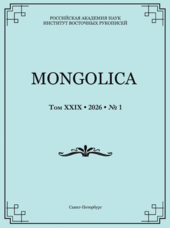
Mongolica. Vol. XXIX, No. 1 / Ed. by I. V. Kulganek (editor-in-chief), D. A. Nosov (secretary), M. A. Kozintcev (deputy secretary). St Petersburg, 2026. 99 p. ISSN 2311-5939.
PHILOLOGY
Irina V. Kulganek. Mongolian Songs from Nikolai N. Shnitnikov’s Diary (1895) Kept at the Archives of Orientalists of the IOM RAS — 5
The article is devoted to Mongolian songs recorded in 1895 by Nikolai N. Shnitnikov during his journey from Irkutsk to Biysk. The Diary is kept at the Archives of Orientalists of the Institute of Oriental Studies of the Russian Academy of Sciences. These songs are being published for the first time. The article provides our reading of the texts, analysis of the content, commentary, an overview of the circumstances surrounding the recording of the songs, as well as a translation of the songs by N. N. Shnitnikov. The song “Toroy Bandi” is about a real person, a national hero of Mongolia. The song “My Bombre” is an example of lyrical poetry. The song “About Sotmanag” tells the story of a poor girl who is forced to sell her beauty.
Keywords: Mongolian folklore, genre, manuscript, musical notation, North Mongolia, the Song of Toroy Bandi, My Bombre, the Song of Sotmanag, Biysk.
HISTORY. HISTORIOGRAPHY
Wuyundalai. “New Policy” Of The Qing Empire and Mongolia: the Crisis of Border Territory Governance at the Turn of the 19th–20th Centuries — 18
This article analyzes the Qing Empire’s “New policy” (Xinzheng) at the turn of the 19th and 20th centuries from the perspective of borderland governance. Using Mongolia as a case study, it demonstrates how reforms aimed at imperial modernization and administrative unification undermined traditional institutions, intensified resistance, and accelerated the disintegration of the late Qing state.
Keywords: New policy, Qing Empire, Mongolia, borderlands, the Year of the Metal Pig (1911), imperial crisis.
Andrey S. Saraev. The Origin of the Turkic Languages According to the Soviet Historians of the Nomadism — 28
The scheme called “A genealogical tree of the Turks before the 5th century CE” published in Lev N. Gumilev’s book “Khunnu” (Moscow, 1960) gives a clue to an earlier unidentified group of theories which deals with the origin of the Turkic-spoken milieu. Their principal idea was that the Turkic languages had begun as somewhat like a pidgin. Turkic languages had emerged as a result of contacts between Proto-Mongols of the Central Asia and so-called “Ting-ling”, a people known only from the ancient Chinese chronicles that is considered as the Europoids of the South Siberia in the last centuries BCE. In the 1930–1940s these theories represented an attempt of several nomadologists from Leningrad and Moscow (Sergey P. Tolstov, Aleksandr N. Bernshtam, Lev N. Gumilev, Sergey V. Kiselev) to quit the contradictions of the early “Altaic theory” and the official Soviet “Japhetic theory” of Nikolay Ya. Marr.
Keywords: Turkic languages, Altaic studies, Ting-ling, proto-Mongols, Japhetic theory, Lev Gumilev, Sergey Tolstov, Aleksandr Bernshtam, Leonid Potapov.
RELATED DISCIPLINES
Igor A. Alimov. «Dong Jing Meng Hua Lu»: All Internal and External Departments — 56
This article focuses on the unique Chinese text of the 12th century “Dong jing meng hua lu” by Meng Yuan-lao — an unparalleled written source in Chinese history providing comprehensive information on urban life during the Northern Song period. It constitutes the fifth publication in a series of works dedicated to “Dong jing meng hua lu”, and includes a complete annotated translation of the sections “All Internal Departments” and “All External Departments”.
Keywords: China in the 10th–13th centuries, Song era, Chinese city, Meng Yuan-lao, “Dong jing meng yua lu”.
Youli A. Ioannesyan. The Islamic Concept of the Ever-Present “Proof of God” in the World — 64
The article, based on primary sources, examines the evolution of the Islamic concept of God’s expression or Representative on earth. It traces how, from the abstract idea of the “Divine Image” personified in an individual, understood to be the Prophet or prophets, it evolves into the concept of the “Pole/Pole of Poles” in Sufism or the “Proof of God” in Shiism, culminating in the notion of the “Perfect Shiite (Deputy of the Hidden Imam)” in one of the Shiite schools — Shaykhism. To substantiate his line of argument, the author uses translated passages from works of famous Islamic thinkers, including Sufi and Shiite ones, with a special focus on the founders of Shaykhism: Shaykh Ahmad Ahsa‘i and Sayid Kazim Rashti.
Keywords: Moslem theology, Shiism, Shaykhism.
TRANSLATIONS
Regina V. Ivleva. Sengiin Erdene. Dsanabadsar — 73
The article offers a translation of the first chapter of the novel “Dzanabadzar” by the contemporary Mongolian writer Sengiyin Erdenе. The novel was written in 1989 and is dedicated to a real historical figure, the head of the Buddhist Church in Mongolia. Despite its innovative nature and high artistic level, the novel has not been translated into Russian to date. The translation presented below was carried out under the guidance of Dr. Sci. (Philology) L. K. Gerasimovich, as a thesis at the Department of Mongolian and Tibetan Studies (the Faculty of Oriental Studies at St. Petersburg State University). This is the first time the novel has been published. The entire novel is planned to be published. In addition to the translation, the reader will find a preface and notes.
Keywords: modern Mongolian literature, Buddhism, Mongolia, Tibet, Lhasa, Buddhist visual arts.
ACADEMIC LIFE
Marina V. Fedorova. The Еxhibition «Source of Holy Teaching» in the Russian museum of Ethnography — 93
 PDF-files PDF-files
Full text
Keywords
|