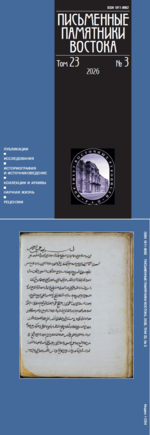
 | PIS'MENNYE
PAMYATNIKI
VOSTOKA Vol. 23, No. 3 (66)
Fall 2026
Journal based in 2004
Issued quarterly
Full text as a *.PDF file PUBLICATIONS
HISTORY, PHILOSOPHY, PHILOLOGY
Youli A. IOANNESYAN. Siyar as-Suluk by Sayyid Kazim Rashti. A Translation from Arabic and Persian. Part 4 — 5
This article contains the final part of the introduced and commented translation of a work by one of the founders of Shaykhism, Sayyid Kazim Rashti, from the collection of the Institute of Oriental Manuscripts of the Russian Academy of Sciences. The translation of this treatise, rendered for the first time into a European language, has been made from a manuscript A 706 and a lithography PS II 157.
Keywords: Shi‘ah schools, Shaykhism, Sayyid Kazim Rashti.
Nikita Ya. BICHURIN (Fr. Hyacinth). Autobiographical Sketch. Introduction and Comments by Irina F. Popova — 18
Autobiographical Sketch by Nikita Yakovlevich Bichurin (Fr. Hyacinth, 1777–1853) is published here after the edition in The Proceedings of the Imp. Academy of Sciences (the 1st and the 3rd Departments, vol. III, issue 5. St. Petersburg, 1855, pp. 665–672). It appeared as expounded by Arabic and Turkic studies specialist, numismatist, archeologist Pavel Stepanovich Saveliev (18141859), who got it from Sinologist, the head of the 11th Russian Ecclesiastical Orthodox Mission in China Dmitrii Semenovich Chestnoi (Archimandrite Avvakum, 1801–1866).
Keywords: N.Ya. Bichurin (Father Hyacinth), autobiographical sketch, Pavel S. Saveliev, Dmitrii S. Chestnoi, Archimandrite Avvakum.
Igor A. ALIMOV. Sometimes They Come Back: The Dead Souls in Zhang Qi-xian’s Collection — 34
This publication introduces the reader to four stories from the collection “Lo yang jin shen jiu wen ji” (洛陽縉紳舊聞記 “Records of what was heard from the officials of Luo yang’s past”) by the Song writer Zhang Qi-xian (張齊賢 943‒1014). The translation into Russian is preceded by basic information about the author and his collection.
Keywords: old Chinese prose, Zhang Qi-xian, Luo yang jin shen jiu wen ji, history of xiaoshuo prose.
RESEARCH WORKS
HISTORY, PHILOSOPHY, PHILOLOGY
Helena P. OSTROVSKAIA. The Concept of “Food” in the Buddhist Worldview — 44
The article is devoted to the analytical description of the concept of “food” in the treatise of the outstanding Buddhist educator of early medieval India Vasubandhu “Encyclopedia of Abhidharma with Commentary”. The author of the article examines the Abhidharmic classification of “four types of food”, which includes material and mental food. It is shown that in the Buddhist worldview, the concept of “food” is interpreted in a direct semantic connection with the idea of the reproduction of suffering in the cycle of births.
Keywords: Buddhism in early medieval India, late Abhidharma, Buddhist worldview, classification of “four types of food”, material food, contact, hope, consciousness.
Sergei L. BURMISTROV. Ātman and the Principle of Anātma: Candrakīrti’s Interpretaion — 51
The principle of anātma, whose essence is the denial of existence of an unchanging “I” (ātman), reborn from one body to another in saṃsāra, is one of the main dogmatic postulates for early Buddhism, and in classical and post-classical Abhidharma. Mādhyamikas Nāgārjuna and Candrakīrti considered ātman and non-ātman as concepts related only to each other but not to the extraconceptual reality and therefore empty. The principle of anātma is understood here as pragmatic in religious sense. Denial of ātman as a means for transforming consciousness in accordance with the Buddhist teaching is effective only at the first stage of the path — on the path of śravakas and pratyekabuddhas. Having attained the fruit of arhat and having reached the bodhisattvas’ path, a person shall also see the emptiness of the principle of anātma itself. At the same time, Nāgārjuna and Candrakīrti in their analysis of the concept of ātman also substantiate the emptiness of both concepts of causality in Indian philosophy — the doctrine of the pre-existence or non-pre-existence of the effect in the cause (satkāryavāda and asatkāryavāda respectively).
Keywords: religious and philosophical systems of ancient and medieval India, religious pragmatics, Buddhism, Madhyamaka, anātma, Nāgārjuna, Candrakīrti, Sanskrit written monuments.
HISTORY AND HISTORIOGRAPHY
TEXTOLOGY, CODICOLOGY, PALEOGRAPHY, ARCHEOGRAPHY
Iakov A. BALASHOV. Chedorlaomer Texts in the Light of New Discoveries. Part 2 — 67
This study sheds light on one of the mysteries of the Old Testament, namely the plot from Genesis 14, which describes the campaign of the coalition of the kings of the East (Chedorlaomer, Amraphel, Tidal, Arioch) into Palestine. The article demonstrates the process of forming these royal names under the influence of a cuneiform source known as the “Chedorlaomer Texts” and reveals its uniqueness. Along with this, the historical context that underlies the plot is revealed. In the course of the work, many new readings were made, carefully hidden by the Babylonian scribe. The problem of reading the last sign in the cryptogram KU.KU.KU.KU.GA2 was solved, and a section of the cuneiform text was discovered in which, albeit somewhat unusually, a phonetically identical syllabic form corresponding to the biblical Amraphel is read. In addition to the analysis of proper names, a transliteration and a commented translation of the Chedorlaomer Texts into Russian are provided.
Keywords: Genesis XIV, Chedorlaomer, Amraphel, Tidal, Arioch, translation, Babylon, Biblical archaeology, cuneiform.
COLLECTIONS AND ARCHIVES
Damir V. MUKHETDINOV, Ilyas R. SADULIN. Arabic Manuscripts from the Collections of the Institute of Oriental Manuscripts of the Russian Academy of Sciences, Copied and Processed by Khusain Faizkhanov: Addition to the Collections of 1854 and 1866. — 84
The paper presents a brief description of the Arabic script manuscripts from Khusain Faizkhanov came to the collection of the Institute of Oriental Manuscripts of the RAS, which were not attested on their origin in the inventories of 1854 and 1866. The paper presents information on 17 manuscripts attested on their origin due to the research on the catalogues and the current work by the paper authors with the collection of the IOM RAS.
Keywords: Khusain Faizkhanov, Oriental studies in Russia, Islamic studies, theology, calligraphy, manuscripts, archival materials.
Hartmut WALRAVENS. Erwin Reifler (16.06.1903–23.04.1966), a Remarkable Sinologist and Linguist. Some Bibliographical Notes — 103
Erwin Reifler was an Austrian sinologist who after having studied at the University of Vienna moved to China in 1932 where he worked at universities, as interpreter and finally as professor at the Université l’Aurore in Shanghai. In 1948 he became a professor of Chinese studies at the University of Washington (Seattle). His specialties were etymology, linguistics, and later metrology. He was one of the pioneers of Chinese machine translation. The paper is based on an autobiographical letter by Reifler and supplemented by the inventory of a box of Reifler’s archive material which the editor acquired at an American secondhand bookshop and which is now owned by the Berlin State Library.
Keywords: Reifler (1903–1966), history of Chinese studies, Chinese bibliography.
Adelaida F. TROTSEVICH. Specialist in Korean Studies and Literature Dmitrii Dmitrievich Eliseev (1926–1994): To the Centenary of his Birthday — 117
Dr. D.D. Eliseev (1926–1994), who worked at the Leningrad Branch of the Institute of Oriental Studies (now — Institute of Oriental manuscripts, Russian Academy of Sciences), was an outstanding specialist in the study and translation of traditional Korean short stories (paeseol) and the first researcher and publisher of manuscripts from the Institute. This biographical sketch is based on the personal memoirs of L.F. Eliseeva and A.F. Trotsevich.
Keywords: D.D. Eliseev, history of Korean studies in Russia, Korean collection of the IOM RAS, Korean manuscripts, traditional Korean short stories.
ACADEMIC LIFE
Ekaterina V. GUSAROVA. The 48th Annual Session of St. Petersburg Arabists “The Coin as an Imprint of History” (St. Petersburg, April 6 and 8, 2026) — 123
Keywords: Session of arabists, Arabic studies, Oriental studies, Aleksey Andreevich Bykov.
Olga M. CHUNAKOVA. Seminar in Memory of A.A. Freiman–2026 (St. Petersburg, May 27, 2026) — 129
Keywords: A.A. Freiman, Iranian Languages and Dialects, Iranian Textology, Iranian Folklore.
REVIEWS
Ilnur M. Mirgaleev.Ottoman Historical Writings of the 15th–16th Centuries on the Tatars. Kazan: Institut istorii im. Sh. Mardzhani AN RT Publ., 2025. — 216 pp. (Mark A. KOZINTCEV) — 134
Keywords: Ottoman-Turkish manuscripts, Ottoman historiography, the Golden Horde, Tatar khanates, medieval Tatars.
Miguel de Cervantes Saavedra. Don Quixote. Translated from English into Sanskrit and into Kashmiri by Jagaddhar Zadoo and Nityanand Shastri. Introduced and edited by Dragomir Dimitrov. 2 vols., Pune Indological Series III–IV. Department of Pali & Buddhist Studies: Savitri Phule Pune University: I vol. — 2019, 293 pp. + pict., II vol. — 2024, 209 pp. + pict. (Ruzana V. PSKHU)— 139
Keywords: Sanskrit, Don Quixote, Kashmiri, Translation Studies, History of Intercultural Communication, History of Literature, Indology.
|