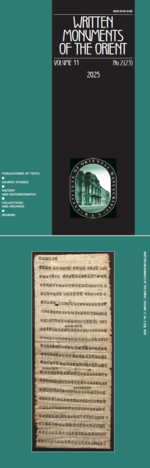
 | Written
Monuments
of the Orient Volume 11, No. 2(23), 2025
ISSN 2410-0145 Issued twice a year
The entire issue as a *.PDF file
CONTENTS
Kirill V. Alekseev. The Varṇārhavarṇa in the Mongolian Manuscript Kanjur — 3
The Varṇārhavarṇa is an ample eulogy to the Buddha composed by the eminent Indian poet Mātṛceṭa not later than the 4th c. AD. The work has survived to the present day in a number of Sanskrit fragments as well as Tibetan and Mongolian translations. Generally, the Tibeto-Mongolian canonical tradition places the Varṇārhavarṇa in the Tanjurs. Nevertheless, the Phugbrag Kanjur contains the incomplete text of the work (ch. 2–12). Notably, the Mongolian manuscript Kanjur compiled in 1628–1629 encloses chapters four and five of the hymn. Both renditions in the Tibetan and Mongolian Kanjurs have characteristic structural features indicating that they could ascend to one and the same Tibetan version of the Varṇārhavarṇa, different from the one in the Tanjurs. Key words: Varṇārhavarṇa, Mātṛceṭa, Phugbrag Kanjur, Mongolian manuscript Kanjur, Tanjur
Lkhagvasuren Enkhsaruul. Comparative Study of Galdantseren Khan’s Oirat Letter Sent to a Khalkha Nobleman Tseren in 1737 — 13
The present article deals with an Oirat letter, which was sent from Gаldаntsеrеn (1694–1745) to the Eastern Mongol nobleman Tseren (1672–1750) in 1737 during the border-line negotiation between the Dzungar Empire (1671–1755) and the Qing
Dynasty (1644–1912). The letter is examined from two aspects. The first compares the original Oirat letter and its Manchu translation of that time, attempting to find distinctions in the content or sentences. The second is to analyse the Oirat letter’s colloquial elements and speech act. Academics generally agree that the precise sound marking capability of the Oirat script makes it easier for components of that time’s spoken language to infiltrate into the written form. Key words: The Dzungar Empire, the Qing Dynasty, an Oirat letter, Manchu translation of that time, colloquial elements in the Oirat letter, perlocutionary speech act
Sun Yingxin. A Study on the Siddhaṃ Fragments Housed in the British Library — 30
In 1909, the Kozlov expedition discovered two volumes of Siddhaṃ xylographs at Khara-Khoto, which are currently housed at the Institute of Oriental Manuscripts of the Russian Academy of Sciences. Fragments overlooked during the initial excavation were subsequently collected by Stein five years later and are now preserved in the British Library. This paper confirms that the two dhāraṇī fragments in the Stein collection, dated 1194 CE, represent missing pieces from the volumes held in Russia. Key words: Sanskrit, dhāraṇī, Siddhaṃ, Tangut, Xixia
Kirill M. Bogdanov. “Six Yogas” Practice in Text from IOM RAS Tangut Fund. Preface, Translation from the Tangut Language
and Commentary — 43
This article presents a Russian translation, commentary and brief textual research of the Tangut manuscript (10th–13th cc.) describing a tantric practice possibly related to the doctrine of “Six Yogas” of the famous Indian tantric master Nāropa. Since the handwriting of this manuscript is nearly illegible, I have published here only part of this text which is more or less comprehensible due to its general meaning and structural completeness. Considering that this research aimed at the identification of the original specific traits of Tangut Buddhism which make it distinct from the neighboring Buddhist traditions that had, in their time, had a strong impact on its formation is a most important trend in this field, the publishing of this textual source could be helpful in this context. Key words: Tangut Fund of IOM RAS, Tangut Buddhism, Tantra, “Six Yogas” Erhan Aydın. Bolshoy-Yaloman III Inscription — A New Reading and Interpretation — 50
Mountainous Altai inscriptions have a special place and importance among the Turkic Runic inscriptions. There are more than a hundred inscriptions in the territory of the Republic of Mountainous Altai of the Russian Federation. Work on these inscriptions continues. The Bolshoy-Yaloman III complex, discovered by A.A. Tishkin, contains one text in Old Uyghur script and three texts in Turkic Runic script. There is only one proposed reading and interpretation of the three Turkic runic texts, published by Tugusheva, Klyashtorny and Kubarev. However, the authors were not able to read most of the inscription and only provided a transliteration. This article presents a new reading and interpretation of three rock inscriptions found in the Bolshoy-Yaloman III complex. After reading and interpretation, explanations were made about the words in the inscription. Key words: Old Turkic, Old Turkic Inscriptions, Mountainous Altai Inscriptions, Bolshoy-Yaloman III Complex, Bolshoy-Yaloman III Inscription Nadezhda Ye. Tikhonova. The Danishmendname Epic: Conceptualization of ‘Sacred’ in the Scope
of the ‘Holy War’ — 65 The large Turkic epic Danishmendname, which tells us a story about the conquests of Danishmendid dynasty in Asia Minor in the 11th c., retained its popularity in the Ottoman empire up until its collapse. At the same time, current public discourses in modern Turkey reveal the new wave of popularity of warrior epics about the legendary Turkic conquerors. Despite the Danishmendname has been fruitful topic of research, by and large, there are generally comprehensive historical, literary and linguistic commentaries to the manuscripts and its published facsimiles. Recent studies on the topic, though, address the Danishmendname in a broader context of Late Medieval frontier epics as an informed source for cultural and political environment of that milieu. Following this latter approach, we assume that Danishmendname constitutes an excellent case study for investigation of cultural memory of Muslim conquests in Asia Minor for several reasons. This epic not only records multiple layers of complex Muslim-Christian interactions in Anatolia, including the accounts of the First Crusade, but also could shed light on the way the lay people, who transmitted the lore, assigned meaning to the world in which they lived. This world, being very unstable with its flexible identities and no tangible allegiances, was imagined as a ‘house of war’ (dār al-ḥarb), where any means of Islamization were tolerable. So, the Muslim conquerors build/ rebuild mosques in newly captured cities, demolish and desacralize the Christian places of worship (so do their Christian counterparts with the mosques), and even perform a miracle to convince ‘infidels’ to convert to Islam. Similar supernatural deeds of Christian monks, however, are perceived as a sorcery, thus, being desacralized. Given the context, the category of ‘sacred’ becomes observable wherever group identities are challenged and put at stake. Thus, by means of discourse analysis, this paper explores how this certain category was manifested both spatially and spiritually in the scope of the ‘holy war’, which is in the center of the plot. Key words: Danishmendname, Islamization of Asia Minor, Muslim-Cristian interactions, the First Crusade, sacralization/re-sacralization/desacralization of space Anastasiia M. Smirnova. Confessional Perception of Historical Memory: Mir Shams al-Din ʻIraqi through the Eyes of the 18th c. Sunni Author (Based on Manuscript B720 from the IOM RAS Collection) — 80
This article examines contradictory assessments of the activities of Shiite preacher Mir Shams al-Din ʻIraqi (1441–1526) in the religious history of medieval Kashmir. The study analyzes fundamental differences in interpretation of his role between contemporary Iranian historiography, which presents him as an outstanding religious reformer, and 18th c. Kashmiri Sunni sources that critically evaluate his missionary activities. Based on a comparison of the manuscript “Waqiʻat-i Kashmir” by Muhammad Aʻzam Didamari from the IOM RAS collection with works written by contemporary Iranian researchers, this study demonstrates how authors’ confessional affiliation influences the formation of historical memory regarding religious figures of the past. Key words: manuscript, “Waqiʻat-i Kashmir”, Mir Shams al-Din ʻIraqi, medieval Kashmir, Shiism, Nurbakhshiyya, religious history, historical memory Ramil M. Valeev, Roza Z. Valeeva,
Gennadiy R. Sharafutdinov. S.E. Malov’s Unpublished Letters to Academician V.V. Radlov from Chinese Turkestan (1910–1915) and Kazan (1917) Kept at the St. Petersburg Branch of the Archive of the Russian Academy of Sciences — 89
January 2025 marks the 145th birthday of Professor Sergey Yefimovich Malov (1880–1957), Corresponding Member of the USSR Academy of Sciences, a renowned expert in ancient Turkic runic and Uighur texts, history, language, and culture of Turkic-speaking peoples, as well as an outstanding educator in the field of Turkology. His early academic biography and classical legacy are associated with two famous research expeditions to Western China (1909–1911 and 1913–1915). In addition, 110 years have passed since the end of his Turkestan expedition and 104 years since his planned third trip to Central China. The scholarly expedition of S.E. Malov is organically woven into the history of Russian and foreign academic and humanities research and discoveries in the important geopolitical and historico-cultural space of Central Asia in the late 19th — early decades of the 20th cc. This article presents a part of the epistolary legacy of S.E. Malov: four letters written to his teacher Academician V.V. Radlov during two periods of Malov’s research journey to Qing China (1910–1915) as well as the last, fifth, letter from Kazan dated January 17, 1917. These letters belong to the Academician’s personal collection kept at the St. Petersburg Branch of the Archive of the Russian Academy of Sciences (Fund 177, Inventory 2, File 161). The letters, originally written in Russian, are given in the article in English translation. Key words: Russia, East, Central Asia, Chinese Turkestan, Turkic studies, S.E. Malov, research expedition, letters Ilya V. Zaitsev, Tatiana A. Anikeeva. Thesaurus of Islamic Literacy and Scribes of Russia: Historical Background and Contemporary Approaches — 107
Arab-Muslim scholars had come up with a well-developed system of classification of sciences (from the Middle Ages and Abu Nasr al-Farabi and to Hajji Khalifa in 17 c. in the Ottoman Turkey). Later attempts have been made to create bio-bibliographic collections of Muslim scholars in Russia, primarily in the Volga region and Dagestan (by Sh. Marjani, R. Fakhreddin, Nadir al-Durgeli). Recently, the process of cataloguing the rich manuscript heritage kept in state and private collections in our country has accelerated significantly. Despite the fact that this cataloging and the
accompanying digitization process are still far from complete, it is possible to see
a unified space of Muslim culture in our country’s history. Such unity, manifested
in a shared, close written culture, has not been fully appreciated. This is due to the fragmentation of materials: texts copied by one person can be found in repositories
in several cities in the Russia and other countries. The same applies to many prominent authors. The “Thesaurus of Islamic Literacy and Scribes of Russia: electronic version” (work on the project is currently underway) in the form of an electronic database,
will compile data on numerous monuments, collections, scribes, madrasas, authors
of original works and translations, as well as on major centers of manuscript production in Dagestan, Crimea, the Volga-Ural region, Siberia. The Thesaurus will
reflect the dynamic exchange of knowledge and texts between the Russian Empire, neighboring Islamic regions, and countries, emphasizing the cultural and religious unity of Russia’s Muslim communities through the interconnection between the written cultures. Key words: Muslim Scholars, Islamic written culture, literary monuments, scribes, bibliographies, biographies, libraries and manuscript collections, electronic catalog |